Encyclopedia
Aventurine: Stone Properties and Zodiac Sign Matches

Geological Formation and Mining Environment
Aventurine typically forms in metamorphic or hydrothermal environments:
- Metamorphic rocks: Schists and gneisses enriched with mica or iron minerals.
- Hydrothermal veins: Silica-rich fluids deposit quartz with suspended reflective inclusions.
Because aventurine forms as part of massive quartz aggregates rather than discrete crystals, mining usually targets large blocks rather than individual gemstones.
Common host rocks:
- quartzite
- schist
- mica schist
- phyllite
- altered volcanic rocks
The geological setting influences both the durability and the color of the extracted stone.
Methods of Extraction
The extraction of aventurine depends on deposit size, depth, and quality of material. Unlike precious gemstones, aventurine is mined more similarly to industrial minerals, though care is taken to preserve pieces large enough for carving and jewelry.
1. Open-Pit Mining
This method is used in the majority of commercial deposits, particularly in India, China, and Brazil.
- Large areas of surface rock are removed to expose quartz-bearing layers.
- Heavy equipment such as bulldozers, excavators, and hydraulic drills are used.
- Blocks of aventurine-bearing rock are fractured using controlled blasting.
- Extraction continues layer by layer, with waste rock removed continuously.
Advantages:
- High yield
- Cost-efficient for large-scale production
- Suitable for shallow deposits
Disadvantages:
- Landscape alteration
- Large volumes of leftover material
- Requires surface restoration efforts
2. Quarrying
In regions like Russia and Brazil, aventurine is extracted from stone quarries, similar to marble or granite mining.
- Workers cut large slabs of quartzite containing aventurine.
- Diamond wire saws and circular saws are often used for precision.
- Large blocks are then transported for further processing.
Quarrying yields high-quality material in consistent shapes, making it ideal for architectural and interior design use.
3. Manual Extraction (Small-Scale Mining)
In smaller deposits — such as those in Nepal or Tanzania — extraction may be more traditional:
- Hand tools such as hammers, chisels, and picks are used.
- Small blocks or nodules are collected from surface exposures.
- Manual sorting occurs at the mining site.
This form of mining supports local crafts and small-scale gemstone trade.
Processing and Sorting After Extraction
Once aventurine is mined, the raw material goes through several stages before it becomes a polished gemstone or crafted object.
1. Initial Sorting
Stones are separated based on:
- color uniformity
- intensity of aventurescence
- presence of cracks or impurities
- grain size and structural integrity
High-grade pieces are reserved for jewelry, while lower-grade material may be used for carvings, décor, or industrial applications.
2. Cutting (Slabbing and Shaping)
Blocks are cut into slabs or smaller pieces:
- Slabs are used for large projects like tabletops or statues.
- Smaller pieces become cabochons, beads, pyramids, spheres, or carvings.
Because aventurine contains inclusions, cutters must orient the stone carefully to maximize its shimmering effect.
3. Polishing
Aventurine polishes to a glossy finish using:
- diamond abrasives
- cerium oxide compounds
- progressive grit polishing wheels
Proper polishing enhances aventurescence, making it more visible and luminous.
4. Final Quality Grading
Finished stones are graded based on:
- brilliance of the sparkle
- clarity and consistency of color
- absence of structural defects
- smoothness of polish
Premium-grade aventurine is used in fine jewelry and artisanal pieces.
Economic and Environmental Considerations
Aventurine mining has both economic benefits and environmental impacts.
Economic Importance
- Provides employment in rural areas
- Supports local jewelry and craft industries
- Contributes to export revenue in India, Brazil, China, and Russia
- Feeds global demand for wellness, Feng Shui, and metaphysical products
Environmental Impact
Mining can cause:
- deforestation
- soil erosion
- water pollution
- habitat disruption
However, responsible mining initiatives — replanting, controlled blasting, water treatment systems — are increasingly adopted by major producers.
Rarity and Market Value
Aventurine is not uniformly rare, but its value depends on color quality and strength of aventurescence:
- High-quality green aventurine (Indian fuchsite-rich) is abundant yet highly valued.
- Blue aventurine is moderately rare.
- Red and orange varieties are less common and sometimes fetch higher prices.
- Black aventurine is rare and unique in appearance.
Market value also increases with craftsmanship, especially in large statues, carved talismans, and polished spheres.
Colors and Varieties of Aventurine
Aventurine is one of the most color-diverse varieties of quartz. Its hues are determined not by pigments within the silica matrix, but by the mineral inclusions that give the stone its signature shimmer. Because these inclusions vary in composition, size, concentration, and orientation, aventurine displays a remarkable range of colors — from soft greens and earthy reds to elegant blues, warm yellows, and even deep blacks.
Understanding the differences between aventurine varieties is essential for gem collectors, jewelry makers, energy practitioners, and anyone seeking a talisman with a particular aesthetic or symbolic resonance. Each color has a distinct mineralogical composition, formation environment, and appearance — which also influences its metaphysical associations and market value.
What Determines Aventurine’s Color?
Aventurine’s color is primarily the result of its inclusion minerals, not the quartz itself, which is naturally colorless or milky. These inclusions act as tiny reflectors inside the stone, scattering light and giving each variety a unique internal glow.
Key factors affecting color:
- Type of inclusion minerals (fuchsite, hematite, goethite, mica, dumortierite, ilmenite)
- Particle size — larger plates produce stronger sparkle; smaller particles give a soft, velvety shimmer
- Density of inclusions — sparse inclusions create a gentle glow, while concentrated inclusions lead to intense aventurescence
- Chemical impurities — trace elements like chromium, iron, and copper modify color tones
Each color of aventurine is effectively a signature of the geological conditions in which it formed.
Green Aventurine
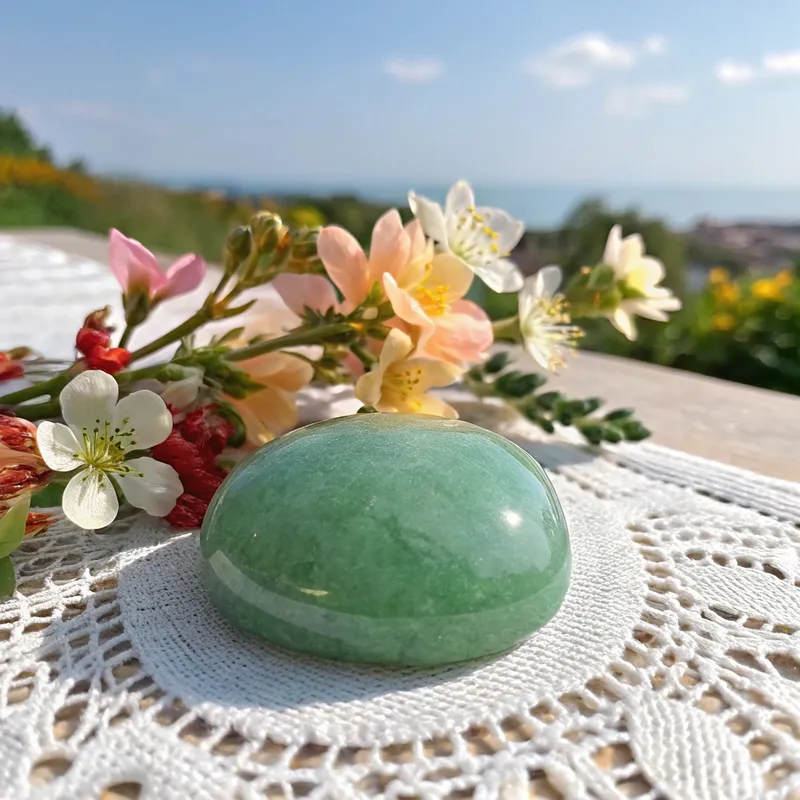
Green aventurine is the most iconic and widely recognized form of the stone. It is often referred to as the “Stone of Opportunity,” reflecting its long-standing association with luck, optimism, and personal growth.
Mineralogical Composition
- Primary inclusion mineral: Fuchsite — a chromium-rich mica
- Trace elements: Chromium (Cr³⁺), sometimes iron (Fe²⁺/Fe³⁺)
- Typical origin: India (Mysore), Brazil, China, Russia
Fuchsite is responsible for the stone’s characteristic green color and silvery sparkle. In high-grade specimens, the inclusions appear as delicate, glittering flakes that illuminate the stone from within.
Color Range
Green aventurine occurs in shades ranging from:
- pale mint
- medium grass green
- deep forest green
- blue-green (high fuchsite content)
- olive and mossy tones
The intensity of green often correlates with the chromium content in the fuchsite.
Visual Characteristics
- noticeable silvery shimmer
- translucent to opaque structure
- soft, velvet-like depth
- uniform or mottled coloration
Green aventurine is prized for large carvings, cabochons, and meditation tools due to its soothing visual warmth.
Red Aventurine
Red aventurine, far less common than green, draws its color from iron oxide inclusions. It has a warm, earthy elegance and a sparkling effect that ranges from subtle golden flashes to deep coppery glints.
Mineralogical Composition
- Primary inclusions: Hematite, goethite, and sometimes lepidocrocite
- Color source: Iron (Fe³⁺)
- Main origins: Brazil, Russia, Chile, Tanzania
Red aventurine forms in environments rich in oxidized iron minerals.
Color Range
- peach
- apricot
- terracotta
- brick red
- deep reddish-brown
The strongest colors come from high concentrations of hematite.
Visual Characteristics
- golden or copper-red sparkles
- semi-opaque matrix
- earthy, grounding aesthetic
Red aventurine is often used in grounding amulets and sculptures.
Orange Aventurine
Orange aventurine is closely related to red aventurine but contains lighter iron-containing inclusions, giving it warm, sunny tones.
Mineralogical Composition
- Primary inclusions: Goethite, hematite (in lesser concentration)
- Trace impurities: Iron compounds
- Origins: India, Brazil, South Africa
Color Range
- light peach
- sunset orange
- honey-orange
- deep amber
The distribution of inclusions often produces a marbled, glowing effect.
Visual Characteristics
- soft golden shimmer
- gentle, warm radiance
- typically more translucent than red aventurine
Orange aventurine is widely used in chakra healing (solar plexus area) and decorative carvings.
Blue Aventurine
Blue aventurine is one of the rarer varieties and is recognized by its cool-toned, slate-blue color and elegant silvery or bluish sparkle.
Mineralogical Composition
- Primary inclusion minerals: Dumortierite, crocidolite, and iron silicates
- Color source: Titanium and iron within the inclusion minerals
- Main origins: Brazil, India, Russia, United States
Dumortierite inclusions give the stone its characteristic indigo or steel-blue color.
Color Range
- pale blue-gray
- medium denim blue
- deep navy
- blue-black mixtures
Some specimens show subtle banding or cloudy zones.
Visual Characteristics
- fine, subtle shimmer
- calming cool tones
- grainy, microcrystalline texture
Blue aventurine is favored for jewelry with a minimalist or masculine aesthetic.
Yellow Aventurine
Yellow aventurine is a sunny, cheerful stone enriched with golden or mustard-colored inclusions.
Mineralogical Composition
- Primary inclusion minerals: Mica, goethite, and iron oxyhydroxides
- Origins: China, Brazil, India
The inclusions scatter light in warm tones, creating a bright, glowing appearance.
Color Range
- pale yellow
- butter-yellow
- golden yellow
- amber
Yellow aventurine’s tones often resemble warm quartz or citrine but with a shimmering texture.
Visual Characteristics
- golden sparkle
- medium translucency
- luminous, uplifting appearance
Yellow aventurine is popular in Feng Shui for generating joyful, expansive energy.
Golden Brown / Brown Aventurine
This variety is sometimes confused with sunstone but is distinguishable by its mica-based glitter and quartz structure.
Mineralogical Composition
- Primary inclusions: Goethite, mica, hematite
- Color source: Iron and manganese compounds
- Origins: India, China, Russia
Color Range
- light tan
- sandy brown
- caramel
- deep chocolate brown
The aventurescence in brown aventurine tends to be warm, golden, and well distributed.
Visual Characteristics
- earthy, grounding tones
- strong reflective particles
- opaque to semi-opaque structure
This stone is often used for statues, bowls, and interior décor items.
Black Aventurine
Black aventurine is one of the rarest varieties and appears almost metallic due to its high concentration of dark inclusions.
Mineralogical Composition
- Primary inclusions: Ilmenite, magnetite, carbon-based minerals
- Origins: Brazil, India, limited deposits in Russia and Africa
These inclusions create a dense black background with subtle silver points of light.
Color Range
- pure black
- charcoal gray
- blue-black varieties
Visual Characteristics
- subtle silvery sparkle
- opaque and dense
- elegant, dramatic appearance
Black aventurine is highly valued in talismanic and protective jewelry.
Rare and Unusual Varieties
In addition to classical colors, several rare forms of aventurine exist.
1. White Aventurine
- contains mica and feldspar inclusions
- soft pearly shimmer
- symbolic association with purity and clarity
2. Gray Aventurine
- subtle crystalline texture
- contains silvery mica flakes
- often used in minimalist jewelry
3. Multi-Colored Aventurine
- displays two or more colors
- forms in zones with fluctuating mineral content
- prized by collectors
How Color Affects the Value of Aventurine
The market value of aventurine is determined by:
1. Rarity
- Blue, red, and black varieties are less common.
- Green aventurine is abundant but prized when high quality.
2. Aventurescence
- Strong, bright sparkle increases price.
- Muddy or weak shimmer reduces quality grade.
3. Color Saturation
- Pure, intense color is more valuable.
- Grayish or dull tones are lower grade.
4. Transparency and Texture
- Smooth grain and even inclusions enhance value.
- Highly fractured or cloudy stones are cheaper.
Aventurine’s remarkable diversity makes it one of the most versatile stones in both jewelry and metaphysical practices. Each color reflects a unique combination of geological conditions and mineral inclusions, creating stones that range from calming greens and energizing oranges to deep, protective blacks. This variety allows aventurine to resonate with different personalities, intentions, and aesthetic preferences, contributing to its lasting popularity across cultures.