
Encyclopedia
Jade: properties of the stone and who it suits according to the zodiac sign

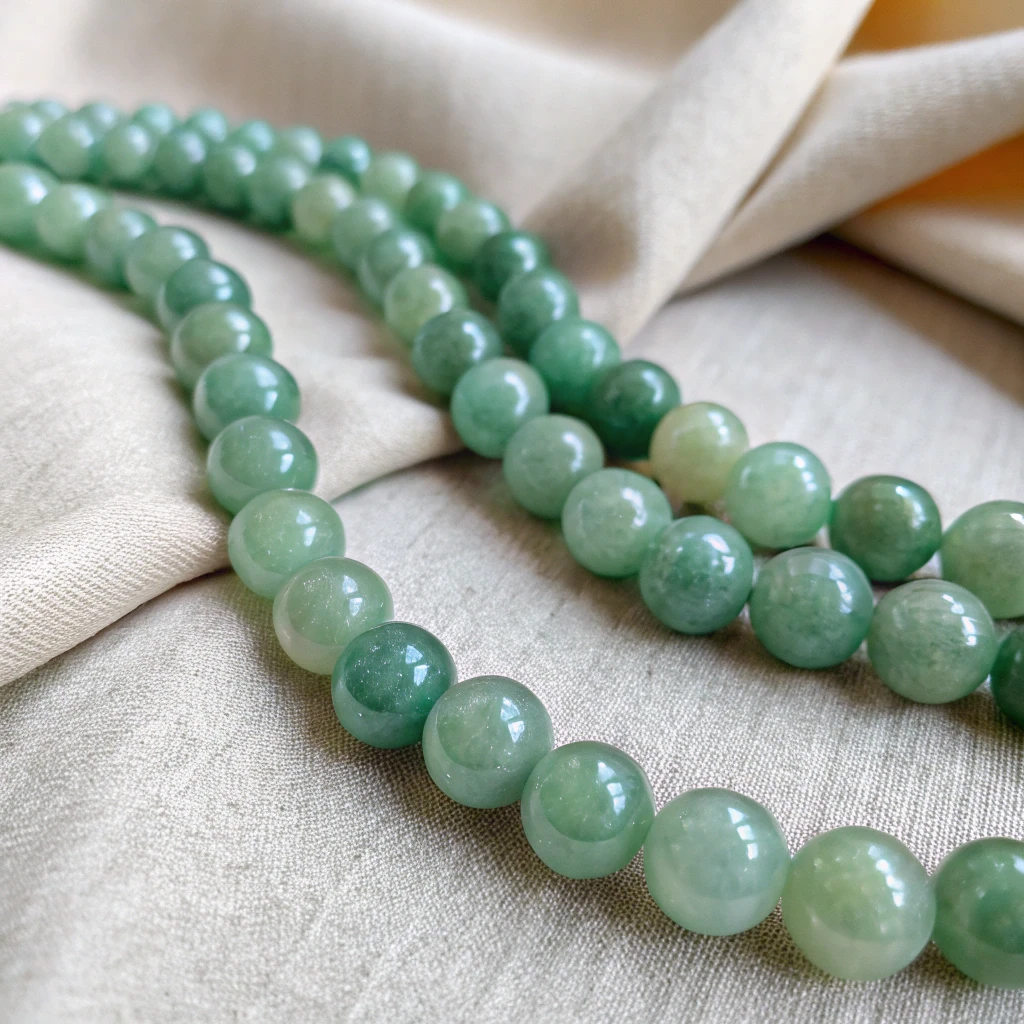
Nephrite Jade Stone
Zodiac Signs
Ruling Planet
Element
Associated Chakra
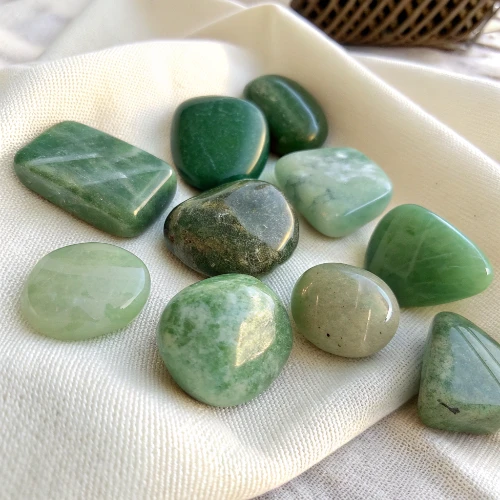

Major Deposits
- Russia (Buryatia)
- Canada (British Columbia)
- China (Xinjiang)
- Myanmar (Burma)
- United States (Wyoming, Alaska)
A mineral with deep earth energy, a diverse color palette, and a history spanning several millennia, jade is considered a priceless stone in some cultures. Its beauty, combined with its magical and healing properties, has made it popular and sought after throughout the ages of human civilization.
Humans began mining jade as early as the Stone Age, during the Neolithic period. Ancient people used the stone to make primitive cult objects, tools, and highly durable weapons.
The mineral has been used to create such unique objects as the 6-meter-high statue of Buddha in China, the sarcophagus of Russian Emperor Alexander III, and part of Tamerlane’s tomb in the Gur-Emir mausoleum (tombstone). Jade has a special significance in Chinese culture and is considered the national stone of that country.
From the point of view of the New Zealand Maori people, jade is also a priceless mineral — a talisman against war, a symbol of power and status. The Maori believe that the power of jade grows as the stone is passed down from generation to generation — accumulating history, it increases its power. The mineral is so important to the Maori that all New Zealand deposits of this stone have been under the exclusive control of this people for more than 20 years.
Jade belongs to the category of first-order semi-precious stones.
Physical and Chemical Properties of Nephrite Jade
From a scientific standpoint, nephrite belongs to the amphibole group of inosilicate minerals, with the chemical formula Ca2(Mg,Fe)5[Si4O11]2(OH)2.
It is a mineral with a glassy or greasy luster, medium hardness (6-6.5 on the Mohs scale), and a conchoidal, waxy fracture. Nephrite is a lightweight stone (density 2.9-3.0 g/cm³). It’s distinguished by its high impact toughness—breaking the mineral is extremely difficult.
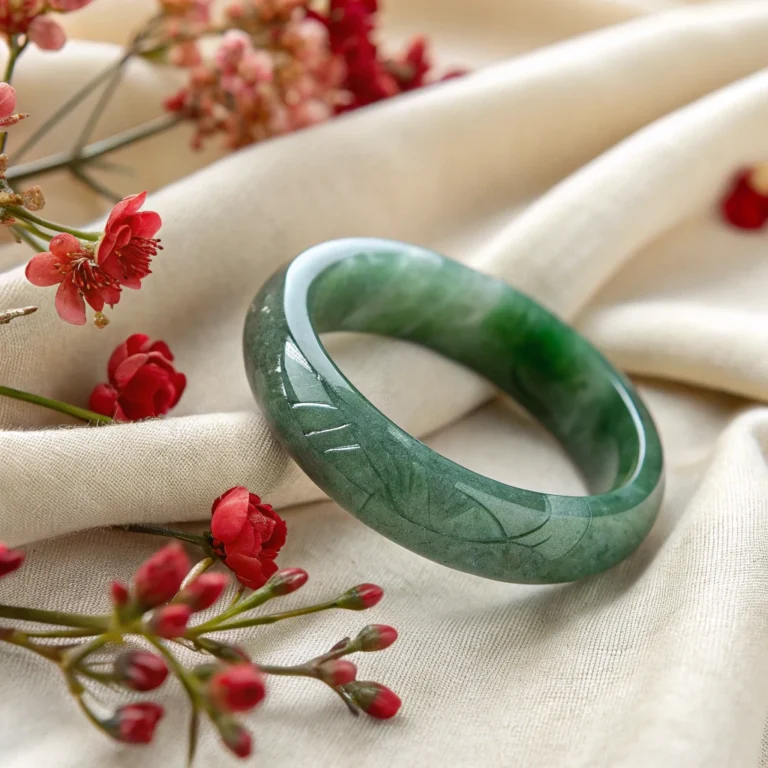
The variety of shades—from nearly white, green (swamp green, emerald, yellow-green, fresh grass color) to dark brown and even nearly black—is due to the presence of various chemical element impurities.
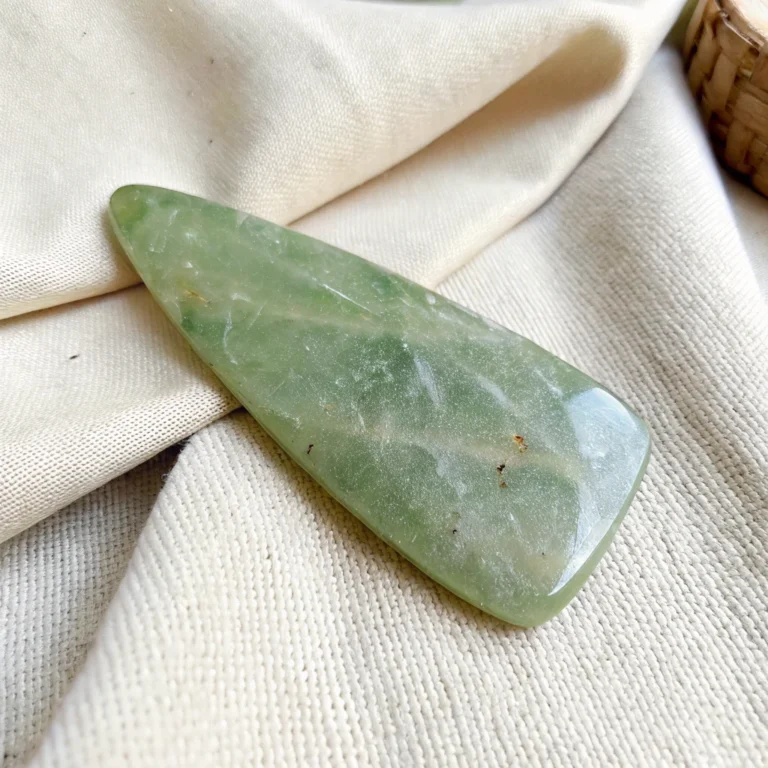
Nephrite Mining
Nephrite deposits are mined in more than 20 countries worldwide, with the largest located in China, Russia, Canada, Myanmar, and the United States.
In Australia, white and green minerals are mined; in Russian deposits—white, black, honey, green of varying intensity, as well as brown, honey-colored, and even with a “cat’s eye” effect. In the United States, minerals of various shades are found, though most are not of particularly high quality. In China, green and white nephrite mining is common, with rarer finds of gray with red and white spots and stripes. New Zealand minerals typically have a bright emerald color, less commonly green with red spots or gray.
The overwhelming majority (13 out of 16) of Russian deposits are located in Buryatia, with two of them—Muya and Baunt—producing rare white nephrite. Virtually all stone from Buryatian deposits is exported to China, though until the 19th century the situation was exactly opposite—Chinese nephrite was imported to the Russian Empire for jewelry and ornamental purposes.
The largest natural nephrite slab ever found weighed 264 tons. The most valuable minerals are considered to be those mined in China and New Zealand.
In the vast majority of cases, the mineral is mined using open-pit methods. The planet’s nephrite reserves have not been precisely assessed. Despite some old deposits nearing depletion, geologists periodically discover new mining locations with significant stone reserves (including in Russia).
What Nephrite Jade Looks Like: Colors and Varieties
In gemology, there are no separate names for nephrite of different colors and shades. The classic color of the mineral is light green, somewhat cloudy, and not particularly vibrant. The following shades are also found in nature:
- Bright green, almost emerald (found in New Zealand deposits)
- Black
- Milky white
- Swamp green
- Grass green
- Yellowish
- Gray
- Pink
- Brown
- Blue
- Red
The mineral’s value depends on its coloration. Solid-colored specimens are valued higher than striped and spotted ones. For green specimens, the more saturated the shade, the more expensive the stone. Minerals of the rarest colors—blue, red, and black—are also highly valued.
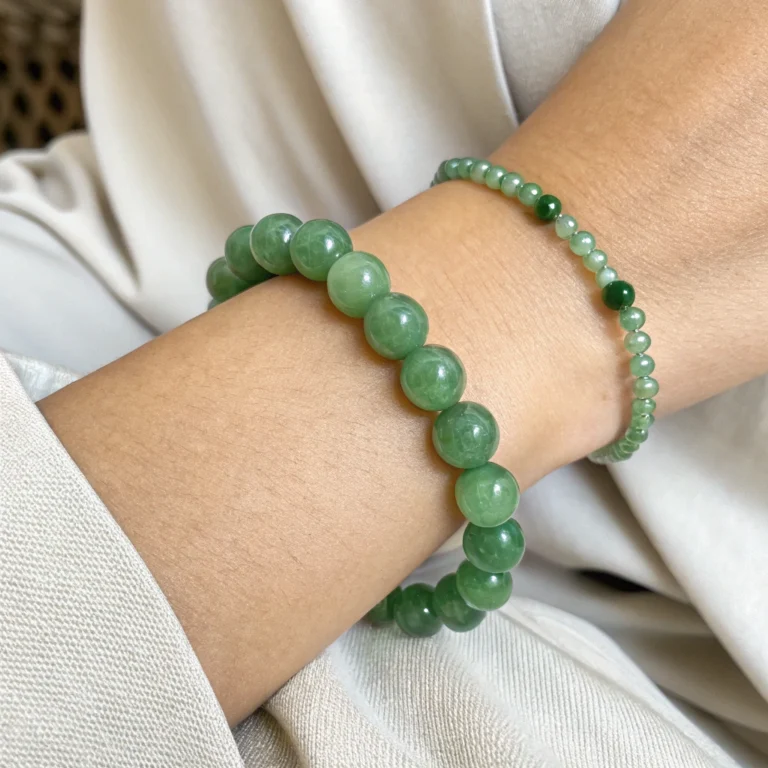
Magical Properties of Nephrite Jade
Nephrite is filled with concentrated earth energy. The magical properties of the mineral vary depending on the shade:
- White — instills self-confidence, brings inner harmony, positive attitude, and stimulates brain function.
- Black — helps the owner organize their life and thoughts, and is considered a talisman of wisdom.
- Green — protects against negativity (including magical), everyday troubles and accidents, helps unlock potential (especially beneficial for creative people).
- Red — amplifies a person’s positive qualities while helping to weaken or smooth out destructive character traits. Makes the character calmer, helping to cope with aggression.
- Blue/Navy — helps a person reach a new level of spiritual development.
- Pink — brings the owner happiness in love, promotes harmonization and preservation of existing romantic relationships or helps find the perfect partner if single.
- Yellow — attracts luck in financial matters, promotes career growth and business development.
The rare red-colored mineral is considered a unique protective charm capable of shielding homes and families from natural disasters.
Nephrite Jade as a Talisman and Protective Charm
The universal quality of nephrite from a magical perspective is its ability to amplify the effects of amulets made from other natural stones. It’s believed that the mineral protects the owner from mistakes, helping to find wise and strategically correct solutions to any question or problem. If the owner takes actions that might bring future difficulties, the mineral in their amulet will cloud over, signaling that something isn’t right.
Properties of Nephrite Jade for Men and Women
Nephrite helps women choose the ideal life partner, protects the family hearth, and becomes a talisman for expectant and new mothers. For men, the mineral allows them to become more self-confident and advance more quickly in their careers. Of course, before using the stone as a protective charm, it’s necessary to consider its compatibility with the owner.
Meaning of Nephrite Jade: What Does the Stone Symbolize?
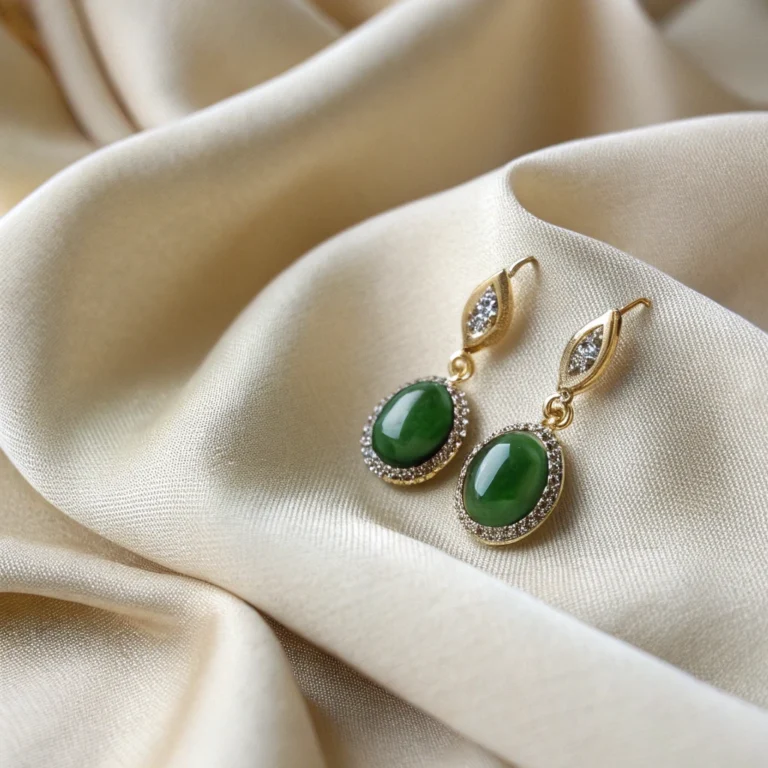
Nephrite symbolizes perfection and immortality, signifying incorruptible power and strength. It’s also believed that this mineral is a reflection of Earth as a cosmic body, embodying earthly energies permeated by “rays” from the Cosmos.
Nephrite in China: The Stone’s Role in Chinese Culture
In China, nephrite has long held the status of an imperial stone, the “king” of all minerals. Embodying the harmony of heaven and earth, it’s considered a symbol of eternity and wisdom. In Ancient China, people believed that nephrite could grant immortality. Milky white stones with a matte luster hold the greatest value in Chinese culture. In the past, only the emperor himself had the right to own such a mineral.
The earliest nephrite artifacts discovered in China had ritual purposes and are approximately 5,000 years old.
The Chinese believe that the mineral relieves fatigue and charges with life energy, and can also transfer its properties to what it touches. Therefore, crushed mineral was often used as a healing remedy, and nephrite tools were used in preparing medicines.
Nephrite Jade Compatibility with Zodiac Signs
Nephrite is a mineral with a pronounced Earth element energy. It’s perfect as a protective charm for people born under the zodiac signs of Taurus, Virgo, and Pisces, and makes an ideal talisman stone for Aquarius.
Blue-shaded stones suit Gemini. Black nephrite becomes an effective amulet for Cancer. Capricorns suit amulets with nephrite of any shade, as the stone is friendly to this zodiac sign.
Leos can wear white and red-shaded minerals. Libras suit white stones.
Scorpios can wear nephrite without worry, with yellow stones having a particularly beneficial influence on this sign.
Nephrite Jade Compatibility with Names
The mineral’s compatibility with masculine and feminine names directly depends on the harmonious combination of the stone’s energies with the name’s energy. Nephrite amulets suit men with the names Kyle, Matthew, Timothy, and William. The stone also makes an excellent protective charm for women with names beginning with “M,” as well as for Eva, Jane, Katherine, and Lucy.
Nephrite Jade Compatibility with Other Stones
Nephrite, possessing pronounced earth energy, is well compatible with other minerals of the Earth element—turquoise, chalcedony, onyx, malachite, and cacholong. The only exception among earth element minerals is jasper—it’s incompatible with nephrite.
The mineral harmoniously combines with Water element stones—chrysolite, emerald, aquamarine, opal, and others.
Nephrite is not recommended to be worn with fire element minerals—their energies don’t harmonize with each other. Therefore, nephrite amulets shouldn’t be worn with jewelry containing diamond, ruby, coral, or garnet.
The stone’s combination with Air element minerals is neutral, so wearing nephrite with topaz, amethyst, rose quartz, and other “air” crystals is permitted.
What is Nephrite Jade Used For?
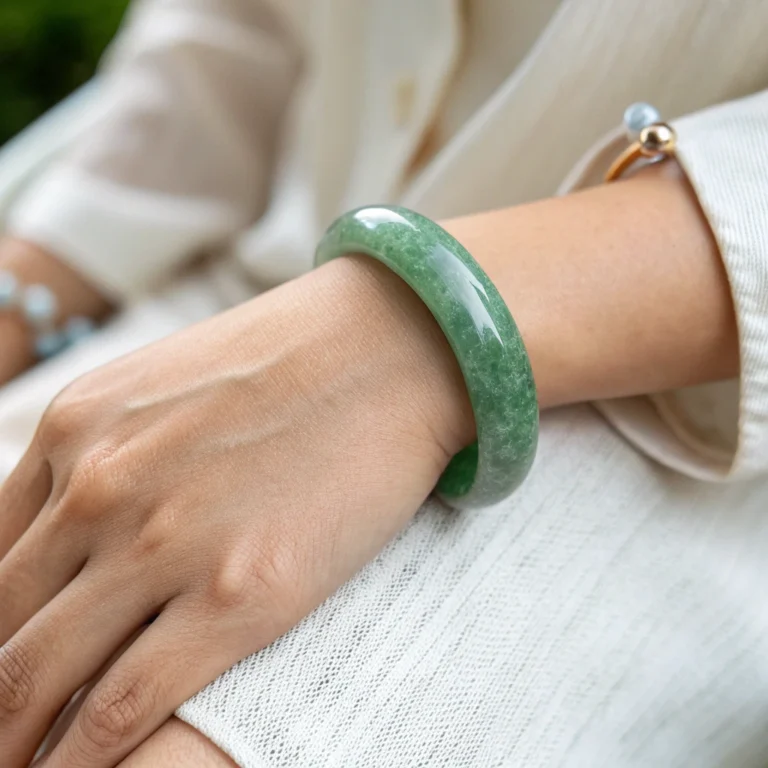
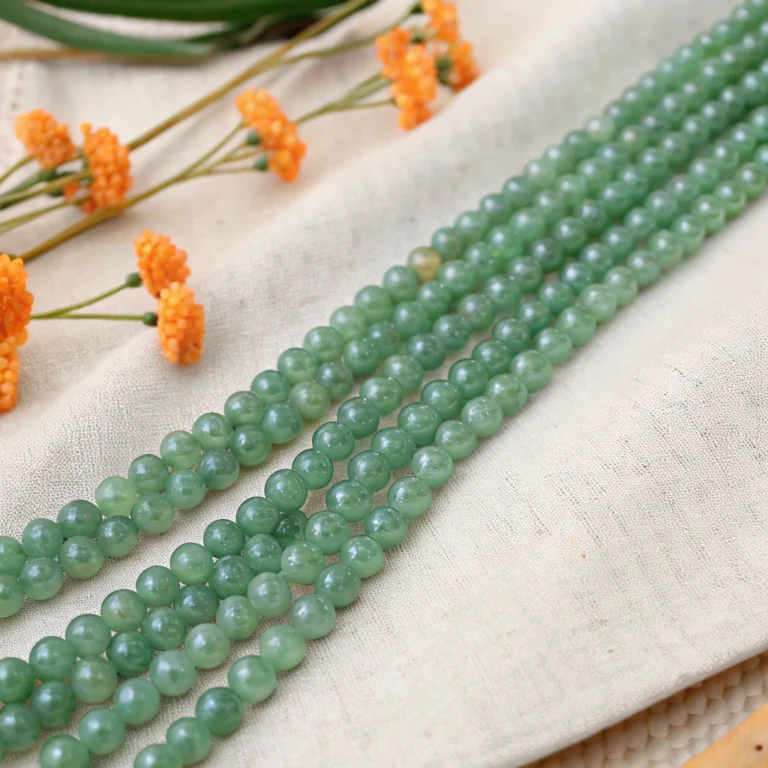
Nephrite is used in jewelry making to create earrings, rings, hair pins, brooches, beads and necklaces, and cufflinks. The mineral is also used to manufacture a wide range of decorative items:
- Jewelry boxes
- Figurines
- Decorative knives
- Stationery (including sets)
- Dishes
- Ashtrays
- Cigarette cases
- Vases
Large nephrite stones are used in saunas and steam rooms, as the stone retains heat well.
The stone is also used for therapeutic purposes. Slightly warmed crystals are applied to the affected area—this is believed to accelerate recovery. Additionally, several healing instruments and devices are made from nephrite, including:
- Mats
- Bars
- Spheres
- Rollers
- Rolling tools
- Plates
- Belts
In most cases, nephrite devices are used for massage and warming therapy.
In ancient China, musical instruments were also made from nephrite.
Synthetic Nephrite Jade
Fraudsters often sell fakes disguised as nephrite.
Usually, counterfeits are made from glass or plastic. You can also encounter fake minerals made from pressed nephrite shavings or chips with plastic and resin added. Sometimes unscrupulous sellers offer customers cheaper, visually similar natural stones—most commonly jadeite.
How to Distinguish Authentic Nephrite from Fakes
The main characteristics by which authentic nephrite can be distinguished from fakes are hardness and temperature. Natural mineral will always feel warm to the touch, slightly warmer than the surrounding air. Plastic fakes have a similar property, but they’re easy to distinguish by hardness—you won’t be able to scratch real nephrite with a knife or needle, whereas steel will easily leave a mark on plastic fakes.
Another distinctive feature of natural nephrite is sound. You need to strike nephrite beads against each other or lightly tap the specimen with a coin. The sound of natural mineral will be resonant and beautiful, while a fake sounds dull and lackluster.
Also worth noting is the luster. The luster of natural stone under a magnifying glass looks velvety.
How to Wear and Care for the Stone
Nephrite is durable, so observing strict storage and cleaning rules isn’t required. To clean dirt, the amulet can be periodically wiped with a sponge soaked in soapy water, then wiped with suede to preserve the stone’s characteristic luster.
Accumulated negative energy can be removed by holding the talisman under running water for a few minutes. Nephrite doesn’t need regular recharging, as its earth energy is very powerful. If you want to enhance the magic of the protective charm, you can take it outside for a few minutes in the rain.
How to Choose and Purchase Nephrite Jade
“Earthly” nephrite is undemanding regarding solar or lunar days, so paying attention to the calendar when acquiring the mineral isn’t necessary. It’s believed that rainwater enhances nephrite’s magic. Therefore, after purchase, it’s recommended to take the stone out in the rain or simply sprinkle it with water at home. Then the amulet is wiped with suede and allowed to get acquainted with the owner—for this, the protective charm should be worn for several days as close to the owner’s body as possible.
An amulet with nephrite allows the owner to call upon the ancient true magic of the Earth itself. The variety of colors and shades allows the mineral to maintain its popularity in jewelry making and decorative interior items, while its magical and healing properties make it an effective protective charm and powerful talisman.