
Encyclopedia
Pyrite Stone: Magical Properties, Meaning & Who It’s Perfect For

Pyrite Stone Overview
Zodiac Signs
- Aries

- Leo
- Sagittarius



Ruling Planet
- Mars

Element
- Fire

Associated Chakra
- Manipura (Solar Plexus Chakra)


Major Deposits
- Spain
- Peru
- China
- Madagascar
- United States
- Italy
Pyrite is the great deceiver stone. Its sharp edges shine with golden brilliance, which is why it was frequently mistaken for gold throughout history. Spanish conquistadors shipped galleons from the Americas to Europe filled to the brim with pyrite, believing it to be precious metal. These failed expeditions ruined many European families. Medieval mystics proved more gracious to this golden impostor, recognizing the mineral’s ability to bestow power and heal ailments.
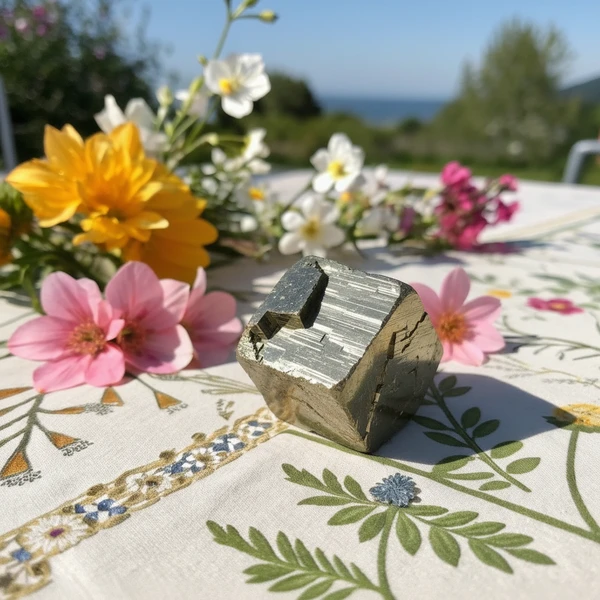
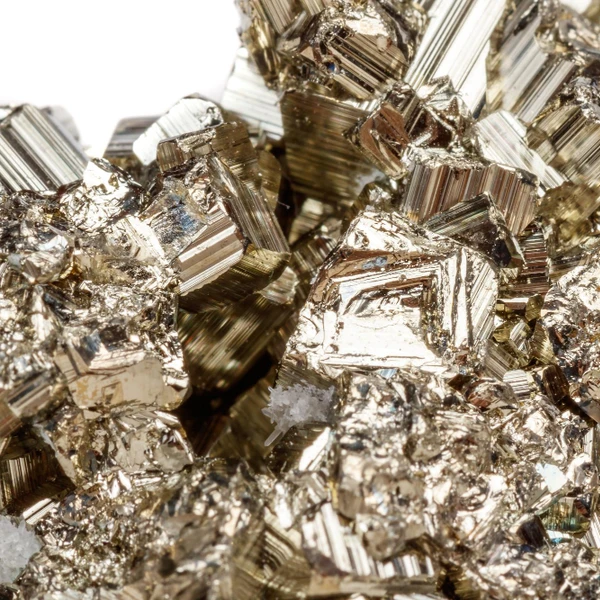
Pyrite is an inexpensive ornamental stone with crystalline structure. In nature, the mineral occurs in cubic formations, less commonly octahedral and pentagonal dodecahedral. Specimens reach 12-16 inches (30-40 cm) in cross-section. Faces display striations of parallel lines. Color on fresh breaks ranges from straw to rich golden, with the shade changing over time to golden with delicate rainbow iridescence.
In nature, prolonged water contact causes mineral oxidation. It rusts and releases sulfuric acid. Under natural conditions, including oxygen contact, the ornamental stone maintains its beauty for extended periods and is completely safe.
From Greek, “pyrite” translates as “fiery.” When struck sharply against metal surfaces, the stone generates numerous sparks. This effect occurs due to sulfur, which the mineral contains abundantly.
During medieval times, the names “Inca stone” and “Fool’s Gold” emerged. These relate to the New World exploration period and the stone’s deceptive appearance. Modern geology offers less poetic variants: sulfur, vitriol, or iron pyrite. The latter is a general name for minerals with bright metallic luster. Pyrite is also known as cat’s gold, health stone, golden impostor, and marcasite (though true marcasite is a distinct mineral).
History and Formation of Pyrite
The mineral forms through several processes:
- Sedimentary environments — On the bottoms of swamps and sulfide-rich water bodies during organic decomposition without oxygen access. Hydrogen sulfide reacts with iron salts dissolved in water, triggering crystal growth mechanisms.
- Hydrothermal processes — Through interaction of hydrogen sulfide vapors, sulfur, and iron-containing compounds.
- Magmatic crystallization — During crystallization of magmatic rocks under pressure.
The largest and most beautiful crystals originated in hot underground solutions. These specimens possess jewelry value; others serve as industrial raw material.
Historical Significance:
Pyrite has been known since ancient times and played fascinating roles throughout history:
- Ancient Egypt — Craftsmen created mirrors from polished pyrite. Priests used it in divination rituals, attempting to glimpse the future in its reflective surfaces.
- India — Golden mineral amulets enjoyed high esteem. People believed they repelled crocodiles and other dangerous creatures.
- France — “Alpine diamond” gained extraordinary popularity. Pyrite adorned belt and shoe buckles, pocket watch chains, and even umbrella tips. However, the mineral oxidized quickly, transforming into limonite (essentially rust).
- Medieval Europe — Pyrite was associated with dwarves and trolls. People believed fairy-tale creatures guarded territories rich in precious stones, and anyone daring to encroach faced certain death. Evidence included a miner’s body found in a Swedish mine, completely covered with pyrite crystals. Modern scientists solved the mystery: the mineral’s ability to rapidly replace dead organic matter meant the deceased miner’s remains petrified in just 60-70 years.
- 19th Century France — French ladies donated their jewels to support Napoleon’s army. In return, they received pyrite jewelry, which they wore with immense pride as symbols of patriotism.
- American Gold Rush — Countless prospectors mistook pyrite for gold, earning it the enduring nickname “Fool’s Gold.” This phenomenon occurred so frequently it became synonymous with false promises and get-rich-quick schemes.
Physical and Chemical Properties
The mineral is iron disulfide (FeS₂). Besides primary components Fe (46.6%) and S (53.4%), it may contain impurities of Au, Co, Ag, Se, Ni, and Cu. These determine pyrite’s color range: from brassy to rich yellow. The stone may contain minor amounts of arsenic.
Physical Properties:
- Luster: Metallic, highly reflective
- Transparency: Opaque
- Mohs hardness: ~6.5
- Density: 4.96-5.10 g/cm³
- Cleavage: Indistinct to poor
- Fracture: Conchoidal to uneven
- Streak: Greenish-black to brownish-black
- Crystal system: Cubic (isometric)
Chemical and Thermal Properties:
- Chemical composition: FeS₂ (Iron disulfide)
- Paramagnetic: Weakly attracted to magnetic fields
- Electrical conductivity: Poor conductor
- Melting point: 1,177-1,187°F (636-642°C)
- Reaction to acid: Decomposes in nitric acid
- Spark generation: Produces sparks when struck against steel
Special Characteristics:
The mineral’s ability to produce sparks led to its historical use in early firearms, particularly in flintlock mechanisms where it occasionally substituted for flint. This pyrophoric property made it valuable before modern ignition methods.
Where and How Pyrite is Mined
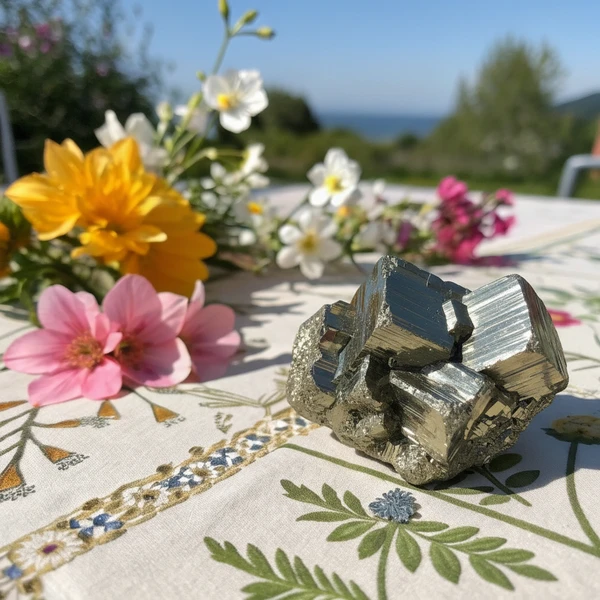
Pyrite isn’t mined separately but obtained concurrently as byproduct material during development of pyrite ores and other valuable rock deposits, such as cobalt or zinc.
The stone occurs worldwide. In Russia, pyrite deposits are located in the Urals, Altai, and North Caucasus. Mining operations exist in Spain, China, Peru, Madagascar, and numerous other countries.
Major Global Sources:
- Spain — Rio Tinto mines produce exceptional specimens
- Peru — Huanzala and Quiruvilca yield museum-quality crystals
- Italy — Elba Island famous for perfectly formed cubes
- United States — Colorado, Illinois, Arizona deposits
- China — Multiple provinces producing various grades
- Canada — Ontario and Quebec operations
- Mexico — Sonora region specimens
Mining Methods:
- Open-pit mining — For near-surface deposits
- Underground mining — For deeper ore bodies
- Byproduct recovery — From copper, gold, and zinc mining
- Artisanal collection — For specimen-quality crystals
The finest jewelry-grade crystals come from hydrothermal deposits where slow cooling allowed perfect geometric formations. These command premium prices among collectors and jewelers.
Colors and Varieties of Pyrite
The ornamental stone’s coloring varies from pale wheat to saturated golden. Three main pyrite varieties are distinguished:
Bravoite:
- Contains nickel, reaching up to 20% composition
- Possesses bright straw-colored luster
- Named after Peruvian mining engineer Jose J. Bravo
- Rarer than common pyrite
- Slightly different crystal habit
Marcasite:
- Also known as white iron pyrite or radiated pyrite
- Discovered by Austrian geologist Wilhelm Haidinger
- Actively used in jewelry industry thanks to attractive metallic luster
- Features delicate pearl-gray shade
- More unstable than pyrite, tends to deteriorate
- Often confused with pyrite but crystallizes in different system
Chalcopyrite:
- Alternative name: copper pyrite
- Besides sulfur and iron, includes copper responsible for brassy shade with greenish reflections
- During oxidation, rainbow film forms on mineral surface
- Also called peacock ore due to tarnish colors
- Softer than pyrite (3.5-4 Mohs hardness)
Color Variations:
- Pale brass yellow — Lower sulfur content
- Rich golden — Ideal iron-sulfur ratio
- Greenish tint — Copper impurities
- Rainbow iridescence — Surface oxidation (peacock colors)
- Steel gray — Marcasite variety
Crystal Forms:
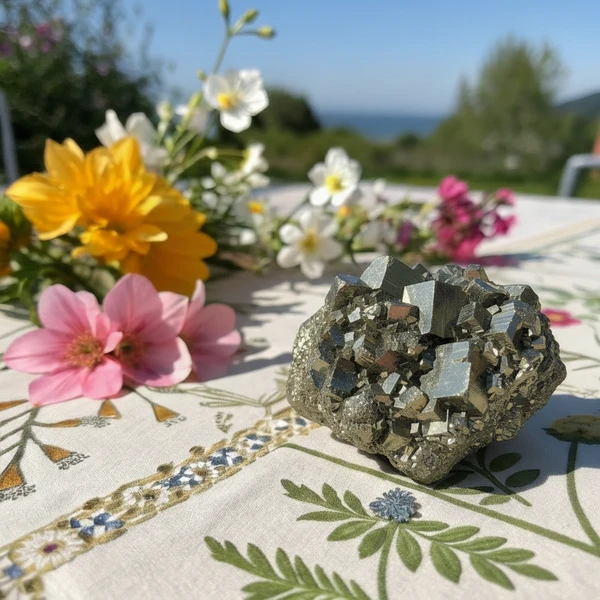
- Cubic — Most common, perfect 90-degree angles
- Pyritohedral — Twelve pentagonal faces
- Octahedral — Eight triangular faces
- Striated faces — Parallel grooves on crystal surfaces
Magical Properties of Pyrite
Pyrite is considered a conduit of power, which is why psychics use amulets and druzy clusters to recover after conducting rituals. If defects appear on the stone, they immediately dispose of it, as energy flows become uncontrolled.
The golden mineral helps concentrate in emergency situations, makes shy people brave, dispels negative thoughts in hypochondriacs, and blocks pessimistic thinking patterns.
Despite being considered a masculine stone, pyrite exerts balanced influence on both genders. It makes women attractive in men’s eyes, while making men strong and resilient. Has family romance disappeared? The fire stone comes to help, reigniting passion’s spark.
The mineral’s powerful energy manifests in its ability to endow owners with leadership abilities and charisma. Luck and wealth growth are guaranteed for those who align with its frequency.
Core Magical Properties:
- Manifestation power — Attracts wealth and opportunities
- Protection shield — Deflects negative energy and psychic attacks
- Confidence boost — Enhances self-assurance and personal power
- Mental clarity — Sharpens focus and decision-making
- Creative spark — Stimulates innovation and problem-solving
- Grounding energy — Connects ambition to practical action
Elemental Magic:
As a Fire element stone ruled by Mars, pyrite channels:
- Warrior energy — Courage in face of challenges
- Transformative power — Destroys obstacles, creates opportunities
- Passionate drive — Fuels ambition and determination
- Dynamic action — Converts thoughts into reality
Magical Properties of Pyrite for Women
Lovely ladies find pyrite helpful in everything: from studies and career to household and intimate life.
- Earrings — Not only complete impeccable appearance but become amulets against evil eye and jealous glances
- Beads and necklaces — Recommended for meetings or entering new groups. The mineral’s complex coloration creates special friendly aura impossible to resist. The wearer will certainly appeal to those around her.
- Left wrist bracelet — Helps find soulmate, attracts romantic opportunities
- Right wrist bracelet — Assists with any tasks: from household to creative endeavors
- Rings — Possess magical power to attract money and financial opportunities. However, avoid greed—if jewelry receives subconscious lust for profit, it stops helping. Wear with gratitude and generosity.
- Unframed pendants — Act like antennae, receiving positive energy and restoring resourceful state. Pendants aid learning; wear them to exams for highest grades.
Specific Benefits for Women:
- Enhances natural magnetism and beauty
- Supports professional advancement in male-dominated fields
- Provides protection from energy vampires
- Balances feminine power with assertiveness
- Stimulates creativity and artistic expression
- Strengthens intuition while maintaining practicality
Magical Properties of Pyrite for Men
Representatives of the stronger sex wrongly ignore pyrite jewelry. Massive rings or bracelets protect from dangers. Wearing them to workouts accelerates positive results. Additionally, the mineral develops analytical and mental abilities.
Specific Benefits for Men:
- Physical performance — Enhances stamina and athletic ability
- Business success — Attracts lucrative deals and partnerships
- Strategic thinking — Sharpens planning and tactical skills
- Leadership presence — Commands respect and authority
- Risk management — Helps assess opportunities wisely
- Protection — Guards against accidents and negative influences
Professional Applications:
- Business owners and entrepreneurs
- Athletes and fitness enthusiasts
- Military and law enforcement
- Financial professionals and traders
- Engineers and technical fields
- Sales and negotiation roles
Pyrite as Talisman and Protective Charm
- Travel companion — Carry pyrite piece during journeys for pleasant travels and friendly encounters
- Dangerous professions — Military personnel, firefighters, stunt performers, and other high-risk professionals should adopt practice of wearing pyrite talisman. Ideally, it should touch skin and be on fabric cord.
- Psychic practitioners — As talisman, mineral is worn by psychics and all those frequently contacting subtle realms. Stone enhances intuition and restores strength after complex sessions.
- Leadership positions — Pyrite suits those holding responsible posts, frequently experiencing nervous tension, and subject to stress. Mineral calms and instills self-confidence.
- Children’s education — To make restless child study, recommend wearing golden stone amulet. It makes troublemaker attentive and focused.
Talisman Applications by Profession:
- Accountants and bankers — Attracts financial accuracy and prosperity
- Lawyers — Sharpens argument and strategic thinking
- Salespeople — Enhances persuasion and closing abilities
- Teachers — Commands student attention and respect
- Public speakers — Boosts confidence and charisma
Creating Pyrite Talismans:
- Small tumbled stones in pocket or purse
- Wire-wrapped pendants on natural fiber cords
- Pyrite cubes on work desks
- Druzy clusters in home or office
- Jewelry worn during important events
Healing Properties and Health Benefits
Crystal healing practitioners value pyrite for numerous therapeutic properties. While not replacing medical treatment, many believe it offers significant health support.
Physical Healing Properties:
- Respiratory system — Supports lung function and breathing capacity
- Blood circulation — Believed to improve blood flow and oxygenation
- Immune system — Strengthens body’s natural defenses
- Bone health — Traditionally used to support skeletal strength
- Skin conditions — Applied for skin inflammation and issues
- Digestive health — May support metabolic function
- Pain relief — Used for general pain management
- Energy levels — Combats fatigue and exhaustion
Mental and Emotional Healing:
- Depression relief — Lifts spirits and combats melancholy
- Anxiety reduction — Calms nervous tension and worry
- Focus enhancement — Improves concentration and mental clarity
- Memory support — Aids retention and recall
- Confidence building — Strengthens self-esteem
- Motivation — Combats lethargy and procrastination
- Stress management — Provides emotional stability
Energy and Spiritual Healing:
- Solar plexus activation — Stimulates personal power center
- Grounding — Connects spiritual insights to practical reality
- Energy restoration — Replenishes depleted life force
- Manifestation — Amplifies intention-setting practices
- Protection — Creates energetic shield
Chakra Healing:
Pyrite primarily works with the Solar Plexus Chakra (Manipura):
- Located in upper abdomen
- Governs personal power and confidence
- Controls willpower and self-esteem
- Manages digestion and metabolism
- Influences sense of purpose and direction
How to Use for Healing:
- Wear jewelry over solar plexus area
- Place stone on body during meditation
- Keep in living or working spaces
- Hold during stressful situations
- Use in crystal healing grids
- Place under pillow for dreams of abundance
Traditional Uses:
- Historically crushed for medicinal powders (not recommended now)
- Used in elixirs (use indirect method only)
- Applied to infected areas (after sterilization)
- Worn for general vitality enhancement
Important Safety Note:
Pyrite can oxidize and release sulfur compounds when wet or exposed to acids. Never make direct-contact water elixirs with pyrite. Always use indirect methods or simply keep the stone near water without contact. Consult healthcare professionals for serious health concerns.
Pyrite Properties for Men and Women
Though pyrite is often called a masculine stone, it provides balanced benefits for both genders, with some variations in how its energy manifests.
For Women:
- Attractiveness — Enhances natural magnetism and beauty
- Confidence — Provides self-assurance in personal and professional life
- Career advancement — Supports success in competitive fields
- Financial independence — Attracts wealth and opportunities
- Creative expression — Stimulates artistic abilities
- Protection — Guards against jealousy and negative attention
- Balance — Harmonizes feminine energy with assertive action
- Intuition — Sharpens gut instincts while maintaining logic
For Men:
- Strength — Builds physical and mental resilience
- Endurance — Increases stamina and persistence
- Leadership — Enhances natural authority and command
- Strategy — Improves planning and tactical thinking
- Risk management — Helps assess opportunities wisely
- Athletic performance — Supports physical training and competition
- Business acumen — Sharpens financial and commercial instincts
- Protection — Shields from professional threats and dangers
Universal Properties for Both:
- Manifestation of goals and dreams
- Attraction of prosperity and luck
- Enhancement of willpower and determination
- Protection from negative energy
- Grounding of spiritual insights
- Stimulation of intellectual abilities
- Boosting of overall vitality
The key difference lies not in the stone’s properties but in how each gender typically channels pyrite’s fiery Mars energy—women often through creative and social manifestation, men through direct action and competition.
Meaning and Symbolism of Pyrite
Ancient Greeks associated the fire stone with Ares. In myths, the fierce war god destroyed everything in his path but favored warriors and helped them in martial affairs. This duality—destruction and protection—perfectly captures pyrite’s essence.
Symbolic Meanings Across Cultures:
- Middle East — Pyrite symbolized wisdom and spiritual enlightenment. Scholars wore it to enhance mental acuity and access higher knowledge.
- Europe — Represented courage and patriotism. Warriors carried it into battle as protection and source of bravery.
- Pre-Columbian Americas — Inca priests used polished pyrite mirrors for divination and communication with spirits.
- Ancient Greece — Associated with solar energy, fire, and masculine power. Linked to god of war and planet Mars.
Modern Symbolic Associations:
- Abundance — Primary symbol of wealth attraction and prosperity
- Protection — Shield against negative energy and psychic attacks
- Action — Represents movement from thought to manifestation
- Solar energy — Embodies sun’s life-giving, energizing properties
- Grounding — Connects spiritual aspirations to earthly success
- Warrior spirit — Symbolizes courage to face life’s battles
- Manifestation — Represents turning goals into reality
In Feng Shui:
Pyrite is used to:
- Attract wealth (place in wealth corner – southeast)
- Protect home (near entrance or windows)
- Enhance career (north area of home or desk)
- Stimulate solar plexus energy (center of spaces)
Personal Symbolism:
For individuals, pyrite often represents:
- Current focus on financial goals
- Need for increased confidence
- Transition into leadership role
- Desire to manifest dreams into reality
- Protection during vulnerable periods
Who Should Wear Pyrite
The Inca stone favors people with pure intentions. It becomes friend and helper in any undertakings. The mineral doesn’t “love” envious and mean-spirited individuals, returning all negativity sent toward others.
Pyrite is also not recommended for persons with unstable psyche. It may amplify irritability and anxiety in those prone to these states.
Ideal Candidates for Pyrite:
- Entrepreneurs and business owners
- Financial professionals and investors
- Athletes and competitors
- Leaders and managers
- Teachers and mentors
- Sales and marketing professionals
- Those seeking financial improvement
- People needing confidence boost
- Anyone starting new ventures
Who Should Avoid or Use Cautiously:
- Those with paranoid tendencies (may amplify suspicion)
- Extremely aggressive individuals (could intensify aggression)
- People with unstable moods (may enhance volatility)
- Very sensitive empaths (energy might be too intense)
When to Use Pyrite:
- Job interviews and negotiations
- Important presentations or speeches
- Financial decisions and investments
- Physical competitions or challenges
- Starting new business ventures
- Overcoming fear or self-doubt
- Need for mental clarity and focus
Pyrite Zodiac Sign Compatibility
Jewelry with pyrite can be worn by all zodiac signs. However, it has favorites: Fire element representatives—Leos, Aries, and Sagittarius.
Maximum Compatibility (Fire Signs):
- Leo ⭐⭐⭐⭐⭐ — Pyrite makes them wiser, more magnetic, facilitates career advancement. Enhances natural leadership while tempering ego.
- Aries ⭐⭐⭐⭐⭐ — Goal-oriented Aries are rewarded with stable financial position and success in romantic affairs. Channels aggressive energy constructively.
- Sagittarius ⭐⭐⭐⭐⭐ — Energetic Sagittarians find calm, soul balance, and peace. Grounds adventurous spirit without diminishing enthusiasm.
High Compatibility:
- Taurus ⭐⭐⭐⭐ — Golden stone becomes reliable friend, revealing who among people is sincere versus who merely uses Taurus’s generosity without reciprocation. Enhances natural practicality.
- Libra ⭐⭐⭐⭐ — Recommended to wear pyrite jewelry minimum once weekly to avoid wrong decisions. Provides decisiveness to naturally balanced sign.
- Scorpio ⭐⭐⭐⭐ — Inca stone protects from curses and evil eye, absorbing negativity. Amplifies already strong protective instincts.
Moderate Compatibility:
- Gemini ⭐⭐⭐ — Helps focus scattered energy and complete projects
- Capricorn ⭐⭐⭐ — Adds warmth to ambitious nature, attracts financial success
- Aquarius ⭐⭐⭐ — Grounds innovative ideas into practical reality
- Pisces ⭐⭐⭐ — Provides confidence and boundaries for sensitive nature
Use with Caution:
- Cancer ⭐⭐ — Should wear accessories with pyrite inserts cautiously. Mineral may cause discomfort, sometimes signaling need to reconsider life path.
- Virgo ⭐⭐ — Must use carefully; intense energy might overwhelm analytical nature or trigger anxiety about imperfection.
Planetary and Elemental Associations:
- Ruling Planet: Mars — Influences person through stone, providing warrior energy and drive
- Element: Fire — Destroys but simultaneously creates conditions for new life emergence
- Day of Week: Tuesday (Mars day)
- Season: Summer (peak fire energy)
Pyrite Compatibility with Names
Friendly pyrite loves all names but prioritizes those relating to fire element.
Highly Compatible Men’s Names:
- Ryan — Celtic origin meaning “little king,” aligns with leadership energy
- Isaac — Means “laughter,” channels joy and optimism pyrite provides
- Nathan — “Gift from God,” resonates with abundance
- Victor — “Conqueror,” perfectly matches warrior energy
- Vincent — “Conquering,” similar victorious vibration
Highly Compatible Women’s Names:
- Agnes — Greek for “pure, holy,” aligns with pure intentions pyrite favors
- Seraphina — “Fiery one,” directly connects to fire element
- Veronica — “True image,” resonates with authenticity
- Victoria — “Victory,” matches success-bringing properties
Names with Strong Fire Energy Connection:
- Names meaning light, sun, fire, or gold
- Names associated with warriors or leaders
- Names connected to abundance or prosperity
- Names with Mars or Aries associations
Universal Appeal:
While certain names resonate more strongly, pyrite’s friendly nature means it works well with anyone approaching it with respect and positive intentions. The stone responds more to the person’s energy than their name.
Compatibility with Other Stones
Pyrite is a strong mineral, therefore it suppresses energy of neighbors in jewelry or fashion ensemble. It “befriends” only hematite, which also belongs to Fire element, and serpentine. The latter represents Earth element, and such harmonious opposite pairing is exception in esoteric world.
Excellent Combinations:
- Hematite — Both are metallic, grounding stones; amplify each other’s protective properties
- Serpentine — Earth element balances Fire; rare harmonious opposite pairing
- Citrine — Fellow manifestation stone; doubles prosperity attraction
- Tiger’s Eye — Both enhance confidence and willpower
Good Combinations:
From aesthetic viewpoint, mineral looks beautiful with:
- Spinel — Complements golden tones
- Jasper — Earth element provides grounding
- Tourmaline — Protects while pyrite attracts
- Pearl — Softens pyrite’s intensity
- Peridot — Adds heart-centered energy
- Citrine — Enhances manifestation power
Neutral Combinations:
- Clear Quartz — Amplifies without conflicting
- Obsidian — Both protective but don’t enhance each other
- Agate — Coexists peacefully without synergy
Combinations to Avoid:
- Water element stones — Opal, moonstone, aquamarine (elemental conflict)
- Extremely soft stones — Pearl, coral (physical incompatibility)
- Air element stones — Amethyst in some interpretations
- Stones requiring moisture — Opal especially dangerous with pyrite
Metal Settings:
- Silver — Most common and affordable setting
- Copper — Enhances Mars energy connection
- Stainless steel — Durable for everyday wear
- Brass — Visually complements golden color
- Gold — Rare due to expense; creates true “gold and gold” look
Wearing Multiple Pyrite Pieces:
Unlike mixing different stones, wearing multiple pyrite pieces is highly effective:
- Ring + necklace = manifestation + protection
- Earrings + bracelet = mental clarity + action
- Multiple small pieces = distributed energy field
How to Distinguish Real Pyrite from Fakes
Pyrite is one of nature’s most common minerals, therefore it’s rarely counterfeited. If doubts exist about specimen authenticity, press it to your cheek. Natural stone remains cool; plastic or glass heats quickly.
Identification Characteristics:
Natural Pyrite:
- Cool to touch, slow to warm
- Substantial weight for size
- Metallic luster even when unpolished
- Cubic or geometric crystal forms
- May show striations on faces
- Greenish-black streak (test on unglazed porcelain)
- Produces sparks when struck with steel
- Slight sulfur smell when rubbed
Fake/Substitute Materials:
- Plastic: Light weight, warms quickly, no metallic properties
- Glass: Lighter than pyrite, no crystal structure
- Painted metal: Paint flakes or scratches off
- Marcasite: More fragile, deteriorates faster (but also natural)
Chalcopyrite Confusion:
Chalcopyrite (copper pyrite) is often confused with pyrite:
- Chalcopyrite: Softer (3.5-4 vs 6.5 Mohs), more brassy yellow, greenish tint
- Pyrite: Harder, paler yellow, better crystal formation
- Both are natural and valuable; knowing difference prevents misidentification
Gold Confusion (Fool’s Gold Test):
Distinguishing pyrite from real gold:
| Property | Pyrite | Gold |
|---|---|---|
| Hardness | 6-6.5 Mohs | 2.5-3 Mohs |
| Streak | Greenish-black | Golden yellow |
| Malleability | Brittle, breaks | Soft, bends |
| Shape | Angular crystals | Rounded nuggets |
| Density | 4.9-5.1 g/cm³ | 19.3 g/cm³ |
Professional Testing:
For valuable specimens:
- X-ray diffraction (definitive)
- Specific gravity test
- Spectroscopy analysis
- Hardness testing
- Acid reaction test (in lab only)
Synthetic and Lab-Created Pyrite
Synthetic pyrite exists and is produced through chemical reactions. It’s obtained through vapor reaction of FeCl₃ and H₂S, then adding FeSO₄ solution with high organic content and heating to high temperatures.
Natural vs Synthetic Pyrite:
Natural Pyrite:
- Forms over millions of years
- Displays natural crystal imperfections
- Contains trace elements
- Varies in color and luster
- Full metaphysical properties
- Higher value for specimens
Synthetic Pyrite:
- Created in days or weeks
- May show too-perfect formation
- Chemically pure (no impurities)
- Uniform appearance
- Limited metaphysical energy
- Lower cost
Industrial Applications:
Synthetic pyrite serves important industrial purposes:
- Sulfuric acid production
- Iron ore processing
- Chemical research
- Semiconductor manufacturing
- Not typically used in jewelry
Laboratory Production Methods:
- Hydrothermal synthesis — High pressure, high temperature
- Chemical vapor deposition — Gas phase reactions
- Precipitation methods — Solution-based growth
- Dry synthesis — Direct heating of iron and sulfur
Metaphysical Considerations:
Most crystal practitioners believe:
- Natural stones carry Earth’s energy
- Synthetic stones lack full energetic properties
- Lab-created useful for study, not healing
- Natural specimens preferred for spiritual work
For jewelry and metaphysical purposes, natural pyrite is strongly recommended. However, synthetic material serves valuable industrial and research functions.
Applications and Uses of Pyrite
Pyrite finds extensive use across multiple industries and applications.
Industrial Applications:
- Sulfuric acid production — Primary commercial use
- Iron ore extraction — Source of iron
- Construction materials — Cement and concrete additives
- Chemical industry — Various sulfur compounds
- Pigment production — Iron-based paints
- Vitriol production — Historical copper sulfate source
Historical Uses:
- Early firearms — Flintlock ignition systems
- Mirrors — Ancient polished pyrite surfaces
- Divination tools — Scrying in reflective surfaces
- Fool’s Gold — Caused numerous failed expeditions
- Fire starting — Spark generation for ignition
Jewelry and Ornamental:
High-quality mineral serves as material for affordable accessories and souvenirs:
- Beaded jewelry — Medium-sized stones create beautiful necklaces and bracelets
- Crushed inlay — Fine powder inlays rings, signet rings, and pendants
- Display specimens — Perfect cubic crystals are collector’s items
- Cabochons — Polished for rings and pendants
- Raw clusters — Decorative druzy specimens
Metaphysical and Healing:
- Meditation tools — Held during practice
- Crystal grids — Manifestation and protection layouts
- Feng shui — Wealth corners and protection
- Chakra work — Solar plexus activation
- Energy work — Grounding and shielding
Collector’s Market:
Perfect pyrite crystals with flawless faces and mirror-bright luster are highly collectible:
- Museum-quality specimens can cost thousands
- Locality matters (Spanish, Peruvian specimens valued)
- Size and formation perfection determines value
- Naturally occurring unusual shapes command premiums
Scientific Research:
- Geological studies — Formation process research
- Planetary science — Found in meteorites
- Origin of life — Role in early biochemistry
- Environmental science — Acid mine drainage studies
Care and Maintenance of Pyrite
Pyrite is fairly fragile and therefore requires careful handling. It’s recommended to store separately from other jewelry, avoid exposure to moisture and high temperatures. With prolonged ultraviolet ray exposure, golden mineral can deteriorate and turn into black powder.
Storage Guidelines:
- Separate storage — Keep away from harder gems that might scratch
- Dry environment — Absolutely critical; moisture causes oxidation
- Room temperature — Avoid extreme heat or cold
- Dark location — Protect from prolonged UV exposure
- Soft cloth pouches — Individual wrapping prevents scratching
- Silica gel packets — Absorb excess moisture in storage
Cleaning Instructions:
- Dry cleaning — Soft, lint-free cloth only
- Avoid water — Never soak or rinse (causes oxidation)
- No chemicals — No soap, alcohol, or commercial cleaners
- Gentle dusting — Soft brush for removing dust
- Oil treatment — Optional: light mineral oil coating prevents oxidation
Protective Treatments:
Gemologists advise:
- Lacquer coating — Periodically renew factory finish
- Plant oil treatment — Use vegetable oil for impregnation to prevent oxidation
- Professional sealing — Have valuable pieces professionally sealed
- Display cases — For specimen collections, use sealed display
What to Avoid:
- Water contact — Causes rust formation and sulfuric acid release
- High humidity — Accelerates deterioration
- Direct sunlight — Can cause extreme degradation
- Acids and bases — React with mineral
- Ultrasonic cleaners — Can damage structure
- Steam cleaning — Introduces moisture
- Rough handling — Brittle structure chips easily
Signs of Deterioration:
Watch for:
- Surface dulling — Loss of metallic luster
- Rust formation — Brownish or reddish deposits
- Crumbling — Structure breaking down
- Powder formation — Black dust around stone
- Smell — Sulfur odor indicating oxidation
Restoration:
- Minor tarnish can be gently polished
- Professional restoration for valuable pieces
- Severe oxidation usually irreversible
- Replacement may be necessary for damaged stones
Energetic Cleansing:
Energetically cleanse the stone simply: wrap pyrite in soft fabric cloth and leave undisturbed for 3-7 days. It’s important to exclude all contact during this period.
Alternative Energetic Cleansing:
- Sunlight — Brief morning sun (10-15 minutes max)
- Smoke — Sage or palo santo (no moisture)
- Sound — Singing bowls or bells
- Visualization — Mental cleansing techniques
- Earth burial — Very brief, in dry soil only
If you follow all recommendations, items with pyrite inserts will serve for many years, maintaining their beauty and energetic properties.
Choosing and Purchasing Pyrite
Pyrite jewelry is chosen literally by love. Rings or earrings should appeal to create energy exchange. Items are purchased on 17th lunar day but not worn immediately—only on 3rd day of lunar cycle. Until then, jewelry rests in dark place.
Selection Guidelines:
Quality Indicators:
- Luster — Bright, metallic, reflective surface
- Color — Rich golden to brassy yellow
- Crystal form — Well-defined faces and edges
- Size — Larger pieces showcase beauty better
- Intactness — No cracks, chips, or deterioration
- Weight — Should feel substantial
Purpose-Based Selection:
- Wealth attraction — Larger pieces, prominent placement
- Protection — Wearable jewelry, daily contact
- Career success — Professional-looking pieces
- Energy work — Natural crystal clusters
- Collection — Museum-quality specimens
- Gift giving — Small tumbled stones or jewelry
Where to Buy:
- Reputable gem dealers — Best quality, accurate information
- Rock and mineral shows — Wide selection, fair prices
- Metaphysical shops — Quality varies, ask questions
- Online retailers — Check reviews, return policies
- Direct from miners — Sometimes possible in mining regions
- Antique markets — Vintage jewelry pieces
Price Guidelines:
- Tumbled stones: $3-10 per piece
- Small jewelry pieces: $15-50
- Quality jewelry: $50-200
- Collector specimens: $100-5,000+
- Museum-quality crystals: $5,000-50,000+
Prices vary significantly based on:
- Size and weight
- Crystal perfection
- Origin locality
- Rarity of formation
- Historical significance
Questions to Ask Sellers:
- What is the stone’s origin?
- Is it natural or synthetic?
- Has it been treated or coated?
- What are care requirements?
- What is the return policy?
- Do you have certificates for valuable pieces?
Timing Considerations:
Beyond lunar timing:
- New ventures — Buy when starting businesses or projects
- Financial goals — Purchase during money-focused periods
- Personal power work — Acquire when building confidence
- Mars retrograde — Some avoid purchases during this time
- Tuesday — Mars-ruled day for connection
Trust Your Intuition:
Most important factor is personal connection:
- Stone should feel energetically right
- Visual appeal matters
- Physical sensation when holding
- Sense of resonance with piece
- Immediate or persistent attraction
When you find your perfect pyrite piece, it will feel like coming home to an old friend who’s been waiting to help manifest your dreams into golden reality.
Final Thoughts:
Pyrite—the stone that fooled conquistadors but won hearts of mystics—remains one of nature’s most fascinating minerals. Its golden gleam symbolizes not the false promise of easy riches but the real power of confidence, action, and manifestation. Whether you seek protection, prosperity, or the courage to pursue your dreams, this fire stone stands ready to be your ally.
From ancient Egyptian priests gazing into polished pyrite mirrors to modern crystal workers programming prosperity grids, this mineral has served humanity’s highest aspirations. It reminds us that true wealth comes not from deception but from developing our inner gold—the courage, confidence, and capability to create the lives we envision.
Choose pyrite with pure intentions, care for it diligently, and it will reflect back your best self, polished to a brilliant shine.