
Encyclopedia
Azurite: Description, Properties of the Stone, and Who It Suits

History and Origin of the Stone
Azurite Stone Meaning
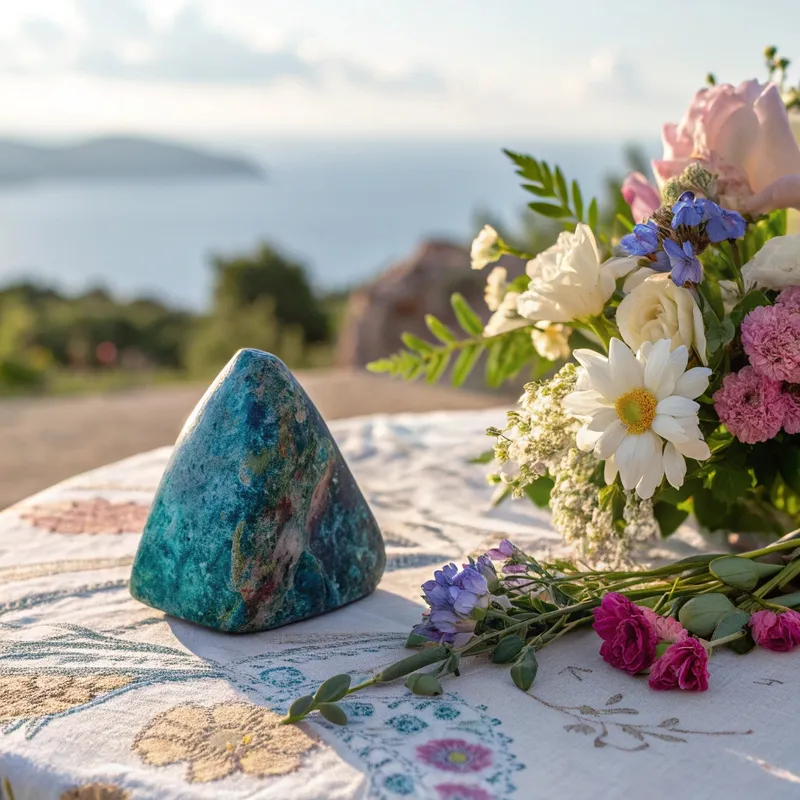
Azurite is one of the oldest and most culturally significant minerals known to humanity. Its deep blue color, reminiscent of a clear night sky or the mysterious depths of the ocean, has fascinated people for thousands of years. The name “azurite” derives from the Persian lazhward, meaning “blue,” which later influenced the French word azur, referring to the bright blue color of the heavens.
In ancient Egypt, azurite was valued not only as a decorative gemstone but also as a sacred mineral. Priests used finely ground azurite for spiritual rituals, believing it enhanced intuition and opened the gateway to higher knowledge. Egyptians also used azurite as a pigment to paint sacred temple walls and sarcophagi, associating its color with divine protection and rebirth.
In Ancient Greece and Rome, azurite symbolized wisdom, clarity, and inspiration. Philosophers and scholars kept azurite amulets to sharpen analytical thinking and deepen concentration. Roman artists used the stone to create vibrant pigments, although azurite tended to fade when exposed to air, symbolically echoing the fleeting nature of earthly life.
During the Middle Ages and Renaissance, azurite became one of the most important pigments for illuminated manuscripts and frescoes. It was widely used in medieval Europe for depicting the Virgin Mary’s robes—blue being the color of purity, protection, and heavenly grace.
Across cultures—from Chinese dynasties to Native American tribes—azurite was believed to hold mystical power. Its connection to the sky, water, and spiritual vision made it a universal symbol of insight, transformation, and harmony.
Physical and Chemical Properties of Azurite
Azurite is a copper carbonate hydroxide mineral with the chemical formula Cu₃(CO₃)₂(OH)₂. Its intense blue hue comes from its high copper content, which absorbs wavelengths of light and reflects the signature ultramarine shade.
Key Physical Characteristics:
- Hardness: 3.5–4 on the Mohs scale — relatively soft and delicate
- Luster: Vitreous to dull, depending on formation
- Transparency: Translucent to opaque
- Fracture: Conchoidal or uneven
- Crystal System: Monoclinic
- Streak: Light blue
Azurite Stone Meaning
Azurite often forms in prismatic, tabular, or needle-like crystals, but it may also occur in massive, globular, or stalactitic formations. High-quality azurite crystals are rare and extremely valuable.
The stone frequently appears alongside malachite, another copper carbonate mineral. In fact, azurite can gradually transform into malachite due to weathering—this process results in the beautiful gemstone azurmalachite, characterized by intricate blue-green patterns.
Where and How Azurite Is Mined
Azurite forms in the oxidation zones of copper ore deposits. It develops when carbon dioxide-rich water interacts with copper minerals underground, slowly creating layers of deep-blue crystal growth.
Major Mining Locations Include:
- Morocco — particularly the Taznakht and Touissit mines, famous for premium azurite crystals
- USA — especially Arizona and Utah
- Mexico — notable for bright blue massive azurite
- Australia — producing large azurmalachite formations
- Namibia — Otavi Mountainland is a world-class source of museum-grade azurite
- France, Germany, Italy — historic European sources
Modern extraction methods remain gentle, as azurite is fragile and can break under pressure. Most mining is done manually to preserve the natural shape and color of the stone.
Colors and Varieties of Azurite
Azurite is best known for its vivid azure blue color, but the shade varies depending on copper concentration, purity, and exposure to air.
Common Color Variations:
- Deep blue (royal blue) — typical high-quality azurite
- Indigo blue — often found in crystalline specimens
- Sky blue — softer shades indicating mixed mineral composition
- Blue-green — transitional forms approaching azurmalachite
Varieties:
- Azurmalachite — a natural combination of azurite and malachite
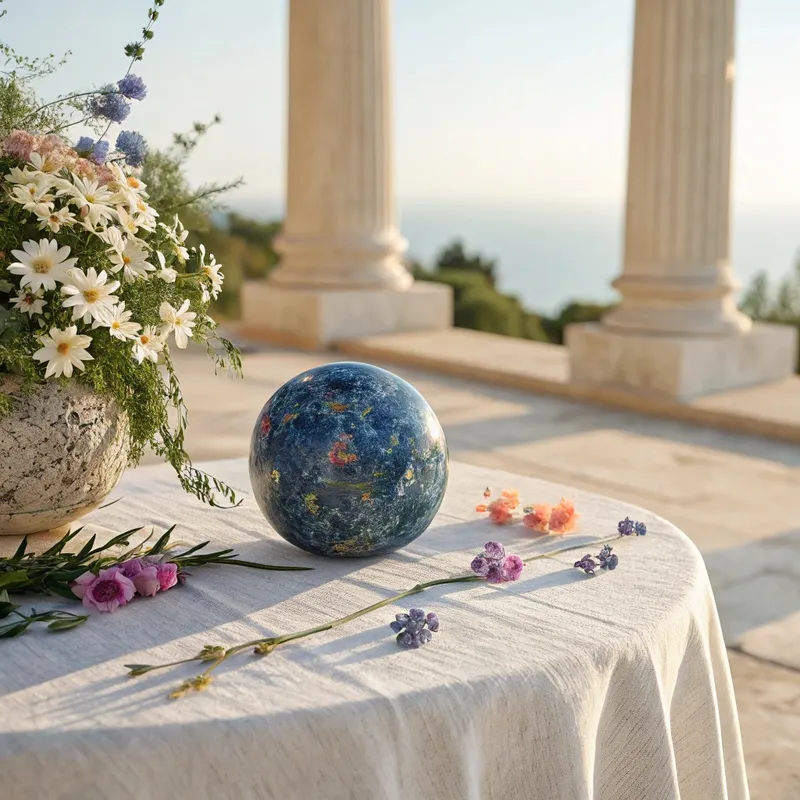
- Blueberry Azurite — spherical nodules from Utah, USA
- Sunburst Azurite — radiating crystal clusters
- Massive Azurite — opaque and uniform, used for carving
Each variety has unique aesthetic and energetic characteristics, making azurite popular in both jewelry and metaphysical practices.
Azurite and Lapis Lazuli — What’s the Difference?
Azurite is often confused with lapis lazuli, another blue stone revered for centuries. However, they differ significantly:
1. Composition
- Azurite: Copper carbonate hydroxide
- Lapis lazuli: Complex rock containing lazurite, calcite, and pyrite
2. Color
- Azurite: Pure deep blue, often with gradient tones
- Lapis: Ultramarine with golden flecks of pyrite
3. Hardness
- Azurite: 3.5–4
- Lapis: 5–5.5 — harder and more durable
4. Formation
- Azurite: Forms in copper deposits
- Lapis: Metamorphic rock
5. Stability
- Azurite: Sensitive to heat, sunlight, and moisture
- Lapis: More stable and better suited for everyday jewelry
Visual Clues:
Azurite looks like concentrated blue ink, while lapis resembles a starry night sky.
How to Identify Fake Azurite
Because natural azurite is rare and valuable, imitations are common.
Most Popular Fakes:
- Dyed Howlite or Magnesite — white stones artificially colored blue
- Dyed quartz — bright but unnatural color
- Ceramic or glass imitations
- Reconstituted azurite — crushed powder mixed with resin
How to Recognize Authentic Azurite:
- Color gradients — natural azurite never has a perfectly even color
- Softness — real azurite scratches easily
- Natural patterns — azurite often has swirls or fibrous structures
- Cool to the touch — like most minerals
- Price — authentic azurite cannot be extremely cheap
- UV reaction — real azurite typically does not fluoresce
If in doubt, a gemologist can perform a professional test.
Magical Properties of Azurite
In metaphysical traditions, azurite is known as the “Stone of Heaven.” It is believed to carry deep spiritual energy that enhances intuition, inner vision, and intellectual clarity.
Energetic Properties Include:
- Strengthening intuition and psychic abilities
- Enhancing the Third Eye Chakra
- Helping with meditation and spiritual insight
- Encouraging emotional healing
- Reducing mental stress
- Opening the mind to new knowledge
- Improving concentration and memory
In many cultures, azurite was considered a portal to higher realms. Shamans used it for dream work and rituals. Today, practitioners of modern spirituality view it as a powerful crystal for awakening subconscious wisdom.
Talismans and Amulets
Azurite amulets were widely used in antiquity. Today, the stone is still believed to serve as a powerful talisman for:
- Students and scholars — improves focus and memory
- Writers and artists — inspires creativity and imagination
- Psychics and healers — supports intuitive work
- Travelers — protects from confusion and bad decisions
- Leaders and speakers — strengthens communication skills
Placed under a pillow, azurite is said to bring vivid dreams and meaningful insights.
Properties of Azurite for Women and Men
For Women
Azurite is associated with emotional harmony and intuition. Women use it to:
- Reduce anxiety and emotional sensitivity
- Strengthen self-confidence
- Improve communication in relationships
- Enhance creativity and inspiration
- Balance hormonal changes through calming energy
For Men
Azurite supports mental clarity and strategic thinking. Men benefit from its ability to:
- Improve decision-making
- Strengthen leadership qualities
- Reduce stress from responsibilities
- Help break negative habits
- Increase analytical thinking
Both genders can use azurite as a tool for self-discovery, mental clarity, and emotional balance.
The Meaning of Azurite
Azurite symbolizes knowledge, truth, intuition, and deep emotional understanding. It bridges logic with intuition, helping individuals see both rational and spiritual perspectives.
Core Symbolic Meanings:
- Wisdom and understanding
- Spiritual awakening
- Deep emotional healing
- Truthfulness and clarity
- Mental transformation
Many consider azurite a “teacher stone” because it reveals hidden patterns, encourages personal growth, and supports those who are seeking clarity in life.
Who Azurite Suits According to the Zodiac
Azurite carries calm but powerful spiritual energy, making it compatible with several zodiac signs.
Best Matches:
- Sagittarius — deepens wisdom, expands horizons
- Pisces — enhances intuition and emotional stability
- Scorpio — encourages self-discovery and inner strength
- Aquarius — fuels creativity and innovation
- Libra — helps with decision-making and harmony
Good Matches:
- Virgo — improves focus and reduces overthinking
- Gemini — enhances communication skills
- Taurus — supports patience and inner balance
Neutral Matches:
- Leo, Aries, Capricorn — can wear the stone occasionally
Less Suitable:
- Cancer — the stone’s intense emotional influence may amplify sensitivity
Compatibility with Names
Azurite harmonizes particularly well with names that carry intellectual or emotional energy. Traditionally, it is believed to support people with names associated with:
- Wisdom: Sophia, William, Edward, Elena
- Creativity: Maya, Adrian, Nicole, Daniel
- Intuition: Anna, Olivia, Mark, Julia
- Calm energy: Emma, Michael, Eva, David
Azurite tends to enhance the natural energy of individuals who are thoughtful, artistic, introspective, or spiritually inclined.
Combination with Other Stones
Azurite pairs well with gemstones that complement its spiritual and calming energy.
Best Combinations:
- Malachite — balances emotional and mental energy
- Lapis Lazuli — enhances intuition and wisdom
- Amethyst — deepens spiritual insight
- Moonstone — supports emotional healing
- Clear Quartz — amplifies azurite’s properties
Avoid Combining With:
- Highly energizing stones like carnelian or red jasper, which can overpower azurite’s gentle frequencies.
Where Azurite Is Used
Azurite has many practical and artistic applications:
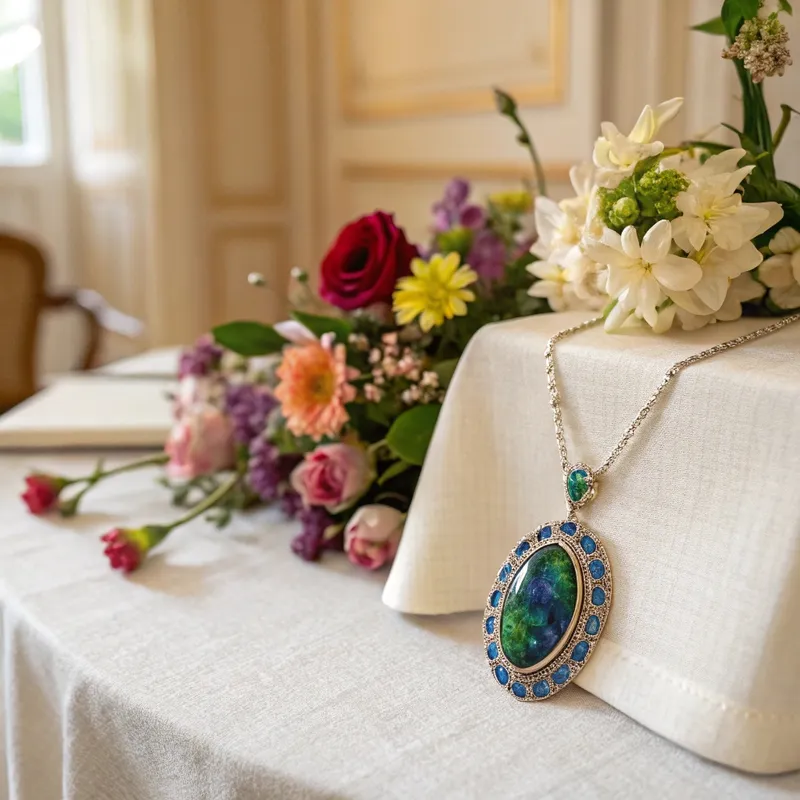
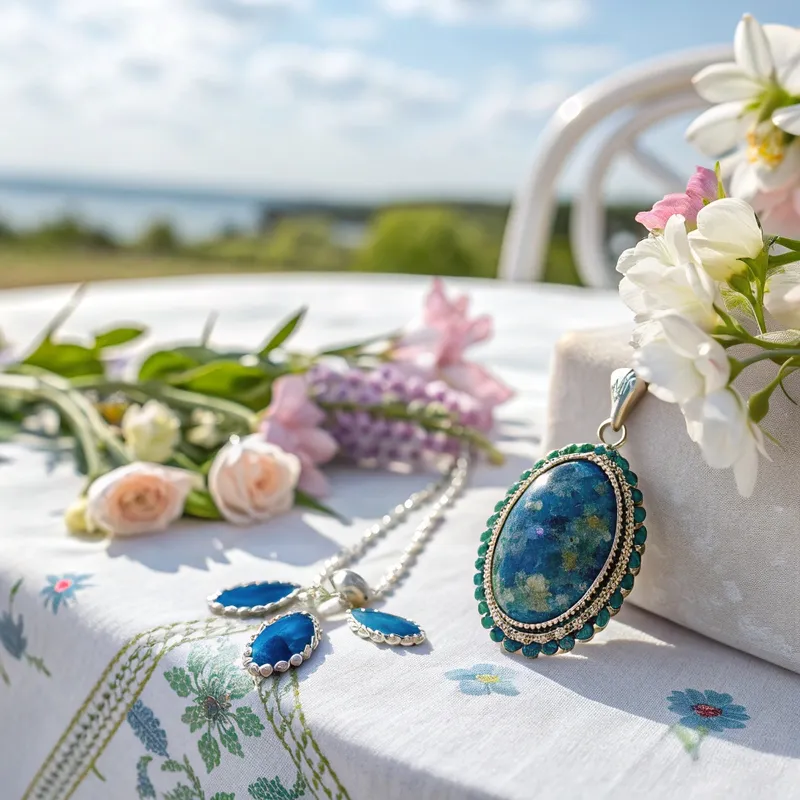
- Jewelry — necklaces, pendants, earrings (worn carefully)
- Decorative objects — carvings, collectible minerals
- Pigments — historically used for painting
- Metaphysical tools — meditation stones, chakra sets
- Museum pieces — rare crystals displayed worldwide
Because the stone is delicate, it is more popular among collectors than in active-use jewelry.
How to Wear and Care for Azurite
Wearing Tips:
- Best worn as a pendant close to the throat or chest
- Avoid rings or bracelets (too easy to scratch)
- Wear occasionally, not daily, to prevent damage
Care Guidelines:
- Do not expose to sunlight — color may fade
- Keep away from water, perfume, and chemicals
- Store in a soft pouch separately
- Clean gently with a dry cloth
- Never use ultrasonic cleaners
Proper care significantly prolongs the beauty of azurite.
How to Choose and Buy Azurite
When selecting azurite, pay attention to:
1. Color Depth
The richer the blue, the more valuable the stone.
2. Crystal Structure
Well-formed crystals are rare and expensive.
3. Pattern
Natural gradients and swirls indicate authenticity.
4. Origin
Morocco and Namibia produce the most desirable specimens.
5. Seller Reputation
Always purchase from trusted gemstone dealers.
6. Certification
For high-value pieces, request a gemological certificate.
7. Price
Authentic azurite is never extremely cheap — very low prices usually indicate dyed stones or imitations.